
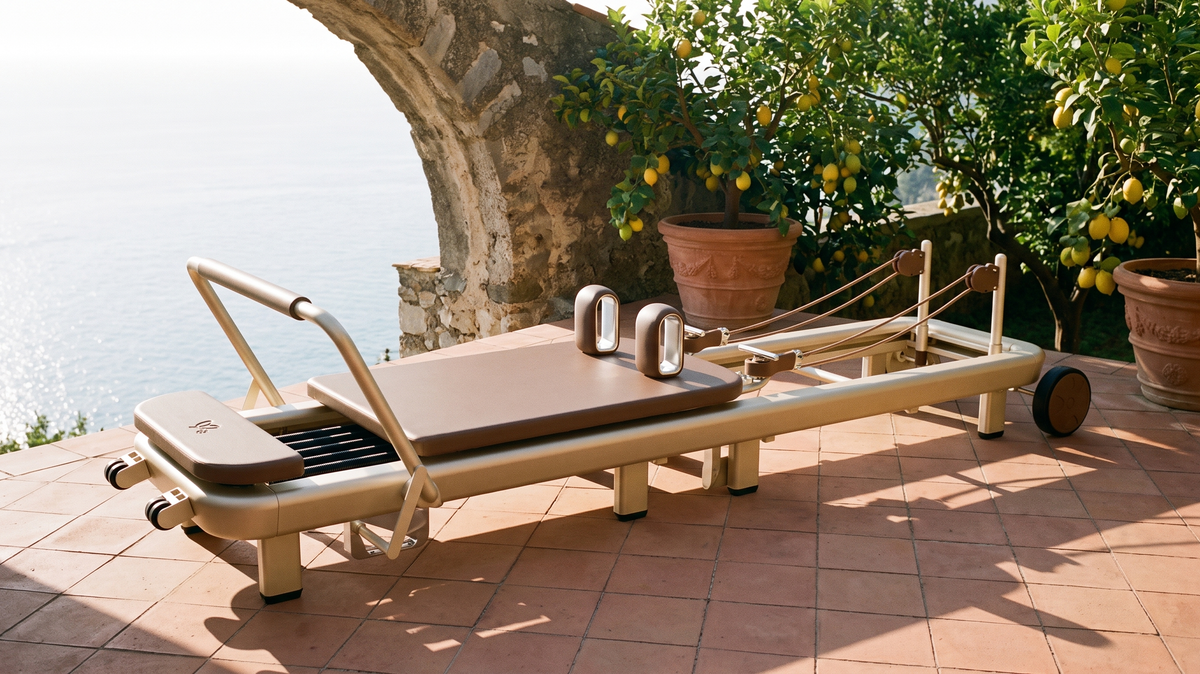
Reformer Pilates is a low-impact form of Pilates performed on a spring-loaded machine called a reformer. A moving carriage, springs, footbar and straps create adjustable resistance and support, allowing exercises to be scaled from foundational movement to demanding full-body strength and control.
Written by the Elemental Movement Lab and reviewed by Samantha Giam, certified classical Pilates instructor. Updated 30 September 2026.
If you are new to reformer Pilates, this guide explains how the machine works, how reformer differs from mat Pilates, what a first session can feel like, and what to consider if you want to practise at home.
What is a Pilates reformer?

A Pilates reformer is an exercise apparatus built around a padded carriage that travels along rails. Springs connect the carriage to the frame and provide adjustable resistance. A footbar provides a surface to press against, while straps and pulleys allow the arms and legs to work against spring tension.
The defining feature is adjustability. Changing spring resistance and body position can make an exercise more supportive, more demanding, or simply different. That versatility is one reason the reformer supports such a broad movement vocabulary.
How does reformer Pilates work?
You may lie, sit, kneel or stand depending on the exercise and your experience. The carriage moves as you press or pull against the apparatus, while the springs provide resistance and assistance.
More spring tension does not automatically mean a harder exercise. In some movements, lighter resistance demands greater stability because the carriage is less supported. Technique, control, range and body position all influence difficulty.
What are the main parts of a reformer?
Carriage. The moving platform that supports the body during most exercises.
Springs. Adjustable resistance connecting the carriage to the frame.
Footbar. A stable surface used by the feet or hands for pressing and support.
Straps and pulleys. These connect the hands or feet to the spring-loaded carriage for pulling and resisted movement.
Shoulder blocks. On many reformers, these help position the body on the carriage during appropriate exercises.
Box. A firm accessory placed on the carriage to change height, position and surface. See what a Pilates box is used for.
Reformer Pilates vs mat Pilates: what is the difference?
Mat Pilates primarily uses body weight and gravity. A reformer adds adjustable spring resistance, a moving surface and straps, which can both support and challenge movement. Neither is universally “better”, and many practitioners use both. Read Reformer vs Mat Pilates and Reformer Pilates Benefits.
Is reformer Pilates suitable for beginners?
Reformer Pilates can be adapted for beginners, but learning the equipment matters. A new practitioner needs to understand spring changes, carriage control, safe transitions and appropriate exercise selection before progressing.
If you are new to Pilates or have an injury, pain, pregnancy-related considerations or another health concern, work with an appropriately qualified instructor or health professional. See our pregnancy and postpartum guide.
What should you expect in your first reformer Pilates session?
Your first session will usually introduce the carriage, springs, footbar and straps before adding more complex movement. Expect to spend time learning where your body sits in relation to the machine and how to control the carriage rather than chasing maximum resistance.
Coordination can feel unfamiliar at first because you are managing posture, carriage movement, resistance and breathing at the same time.
Can you do reformer Pilates at home?
Yes. A home reformer makes regular practice easier, particularly once you understand the equipment and have a repertoire appropriate to your experience.
Before choosing one, consider footprint, clearance, spring system, stability, storage, servicing and where it will live between sessions. Our guide to choosing a Pilates reformer for home works through each of these, and How Much Space Do You Need? covers the measurements.
If the room serves more than one purpose, a foldable Pilates reformer can help, provided folding does not compromise stability or carriage travel. If the reformer will live on a terrace or in a humid space, read Can You Keep a Pilates Reformer Outdoors? first.
About TerraFold™
TerraFold™ is Elemental's full-scale, foldable Pilates reformer: 265 × 60.5 cm open, folding to 136 × 84 × 76 cm. Its wood-free aluminium and composite frame, marine-grade ropes, yacht-grade vinyl and outdoor powder coat let it be used indoors and in covered outdoor spaces. See it in Sydney at Living Edge, Alexandria (from December 2026), or in Singapore at Commune Furniture.
Explore the TerraFold™ Pilates Reformer
Reformer Pilates FAQs
Is reformer Pilates the same as Pilates?
Reformer Pilates is one way of practising Pilates. Pilates can also be practised on a mat and with other apparatus.
Is a Pilates reformer difficult to use?
The basic mechanics are straightforward, but good technique takes time. Beginners benefit from learning spring settings, carriage control and setup first.
Do you need a reformer to do Pilates?
No. Pilates can be practised on a mat. The reformer expands the available resistance, assistance and exercise vocabulary.
Is heavier spring resistance always harder?
No. Some exercises become more challenging with lighter springs because the body must provide more stability.
Is reformer Pilates the same as yoga?
No. They share an emphasis on breath and control but differ in origin, method and equipment. Read Pilates vs Yoga.
Where can I try reformer Pilates in Sydney?
Read Reformer Pilates in Sydney: Studio, Home or Outdoors?
A practice that can evolve with you
The reformer's value is not simply that it adds resistance. It creates a framework in which resistance, support, range and body position can continually change, making reformer Pilates a practice you can keep exploring rather than a single fixed workout.


