
Pilates helps runners and surfers by training the trunk control, hip strength, balance and mobility their sports depend on but rarely build on their own. Running is repetitive and forward-only; surfing demands rotation, spinal extension and explosive pop-ups. Reformer Pilates adds controlled, multi-directional strength with adjustable spring resistance and low impact.
Written by the Elemental Movement Lab and reviewed by Samantha Giam, certified classical Pilates instructor. Updated 30 September 2026.
Why do athletes use Pilates?
Joseph Pilates designed his apparatus to rebuild and strengthen the body, and athletes across many sports now use the method as cross-training. It trains the smaller stabilising muscles and movement patterns that sport-specific training can neglect. Elemental's research arm, the Elemental Movement Lab, applies these principles to equipment for athletes.
Pilates for runners
- Hip and glute strength: side-lying and standing reformer work builds lateral stability that helps control the pelvis on each stride.
- Single-leg control: unilateral footwork mirrors the one-leg-at-a-time demand of running.
- Trunk stability: a stable torso lets the legs and arms work efficiently.
- Foot and ankle work: footwork on the reformer trains control through the ankle and foot.
- Mobility: hip flexor and spinal mobility offset tightness from repetitive running.
Pilates for surfers
- Spinal extension: paddling needs a strong, mobile upper back; prone reformer work trains it.
- Rotation: turns and carving rely on controlled trunk rotation.
- Shoulder stability: strap work builds control for long paddle sessions.
- Pop-up power: exercises like the Long Stretch Series train the plank-to-feet transition. See our Long Stretch technique guide.
- Balance: the moving carriage trains the same reactive balance as a board.
How often should athletes do Pilates?
One or two sessions a week alongside sport-specific training is a common pattern. Place harder sessions away from key runs or big surf days. See How Often Should You Do Reformer Pilates?
Training where you live, and where you surf
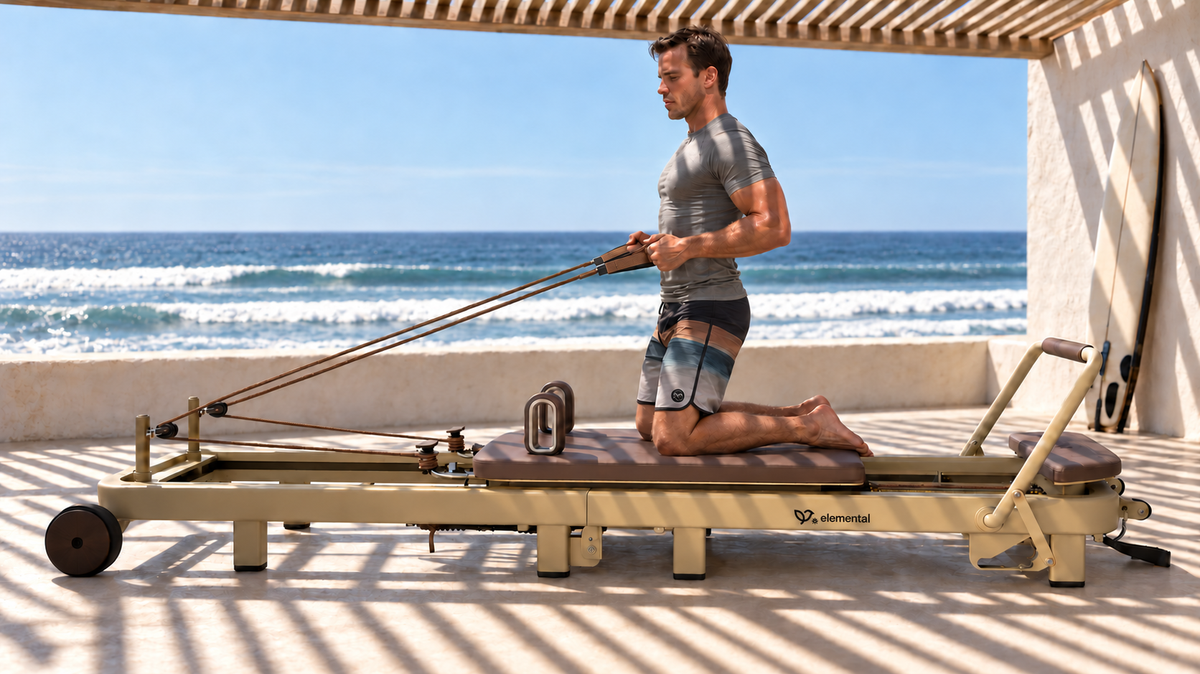
For coastal athletes, a reformer that can live on a covered deck or travel to a holiday house makes consistent cross-training realistic. TerraFold™ is a full-scale foldable reformer with marine-grade ropes, yacht-grade vinyl and outdoor powder coat, designed for considered outdoor use. See it in Sydney at Living Edge from December 2026.
FAQs
Is Pilates good for runners?
Many runners use it to build hip strength, single-leg control, trunk stability and mobility as part of cross-training.
Is Pilates good for surfing?
It trains spinal extension, rotation, shoulder stability and balance, which are central to paddling and riding.
Can Pilates prevent injury?
Strength and control training may help, but no method guarantees prevention. If you are injured, see a physiotherapist or sports medicine professional first.
Mat or reformer for athletes?
Both help. The reformer adds adjustable resistance and a moving surface for balance and power work.


