
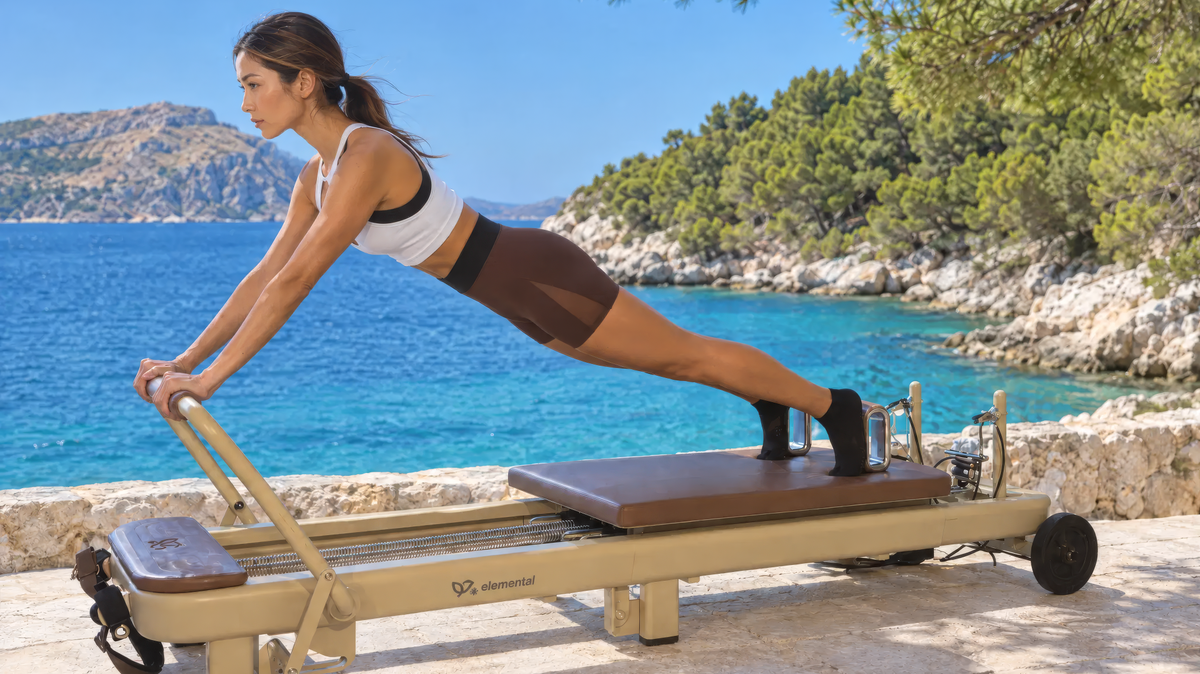
The Long Stretch Series is a family of reformer exercises in which you support your own body between the footbar and the moving carriage: Long Stretch, Down Stretch, Up Stretch and Elephant, building towards Arabesque. Each one trains the same skill from a different angle: holding a strong, connected shape while the carriage moves underneath you. Done well, you feel it in the centre of the body and the back of the shoulders, not in the wrists or lower back.
Written by the Elemental Movement Lab and reviewed by Samantha Giam, certified classical Pilates instructor. Updated 1 October 2026. This guide brings together our own teaching with three leading Pilates references, listed at the end.
Before you start: safety on your reformer
- On an Elemental Reformer TerraFold™, press the footbar down firmly on both sides before every exercise in this series. It has no lock and is held by its own weight, and here your hands put real body weight through it.
- Your feet press against the shoulder rests, so check that the shoulder-rest bolts are tight before you begin.
- Step on and off with care: hands on the footbar first, then the feet.
- This is intermediate to advanced work. Learn it with an instructor before practising alone.
The series at a glance
The classical order is Long Stretch, Down Stretch, Up Stretch, Elephant, then Long Back Stretch. Some schools teach Down Stretch first. Springs vary by school and reformer, so treat the settings below as typical starting points and confirm with your instructor.
| Exercise | Shape | Typical springs | Main challenge |
|---|---|---|---|
| Long Stretch | Plank, hands on the footbar, heels against the shoulder rests | Light, often one | Moving the whole body as one piece |
| Down Stretch | Kneeling, chest lifted into a gentle back extension | Light to medium | Opening the front of the body without pinching the lower back |
| Up Stretch | A high, rounded pike, heels on the shoulder rests | Medium to heavy | Holding the centre lifted between hands and feet |
| Elephant | Standing on the carriage, hands on the footbar, hips high | Medium to heavy | Moving the legs without the shape changing |
| Arabesque | Elephant on one leg, the other leg reaching back | Medium to heavy | Balance with a square pelvis |
The anatomy: what is working
| Exercise | Prime movers | Stabilisers |
|---|---|---|
| Long Stretch | Shoulder flexors and extensors: front and middle deltoids, chest, latissimus dorsi | Transversus abdominis and obliques hold the plank. Glutes and inner thighs keep the legs as one long lever. |
| Down Stretch | Back extensors and the back of the shoulders draw the chest forward and up | Abdominals stop the lower back over-arching. Glutes keep the hips forward. |
| Up Stretch | Hip flexors and lower abdominals fold the body; shoulder extensors move the carriage | Deep abdominals keep the centre lifted. Serratus anterior keeps the shoulder blades wide. |
| Elephant | Lower abdominals and hamstrings draw the carriage back in | Shoulders and arms hold the upper body still. Calves and hamstrings lengthen. |
| Arabesque | Glutes and hamstrings of the lifted leg; abdominals | The hip rotators of the standing leg keep the pelvis square. |
The key moments you should really feel
Long Stretch
At the far point, with the carriage pressed away and your arms angled ahead of your shoulders, you feel the whole front of the body working at once to hold the line. On the return, the back of the arms and the lats pull you home while the centre stays perfectly still.
Down Stretch
As the carriage moves back and the chest reaches forward and up, you feel the upper back working and the front of the chest opening. The lower back should feel long, never pinched.
Up Stretch
Pressing the heels into the shoulder rests while lifting your centre towards the ceiling, you feel the deep, low abdominals working hard. This is one of the strongest abdominal moments in the reformer repertoire.
Elephant
Drawing the carriage in, you feel the lower belly lift and the hamstrings lengthen at the same time. It is a small movement with a big effort, and it should come from your centre, not from the hip flexors.
Arabesque
With one leg reaching back, you feel the glute of the lifted leg and the deep hip of the standing leg working to keep the pelvis level while the carriage glides.
How people get it wrong
| Exercise | Mistake | The fix |
|---|---|---|
| Long Stretch | Hips sag towards the carriage or pike up | Shorten the range. The body moves as one piece, like a drawer sliding. |
| Long Stretch | Shoulders collapse between the arms | Push the footbar away and keep the shoulder blades wide on the back. |
| Down Stretch | Swinging out and letting the springs pull you back | Reach your heels into the shoulder rests and control both directions. |
| Down Stretch | A pinch in the lower back | Use a flatter back and draw the abdominals in. The opening belongs in the upper back. |
| Up Stretch | Snapping the hips down into the plank | Keep pressing the heels into the shoulder rests so the hips lower with control. |
| Elephant | Turning it into a downward dog driven by the hip flexors | Weight even through hands and feet. Lift your centre, then move the carriage. |
| Elephant | Heels lifting off the carriage | Keep the heels down and lighten the load or shorten the range. |
| Arabesque | Lifting the leg higher than the pelvis can hold square | Lift only as high as the hips stay level. |
| All | Wrists aching | Spread the weight through the whole hand, fingers and thumb together around the bar. |
| All | Rushing, the carriage banging home | The return should take as long as the push. |
Variations: a progression ladder towards Arabesque
Move up a step only when the step before is steady and quiet.
| Level | Variation | What it builds |
|---|---|---|
| 1 | Elephant, flat back | The basic two-way stretch between hands and feet |
| 2 | Elephant, round back | Deeper abdominal lift |
| 3 | Elephant, feet turned in and turned out | Hip control in different positions |
| 4 | Elephant, hold and release one hand | Asymmetrical shoulder stability |
| 5 | Elephant, hold and release one foot | Single-leg balance with the carriage still |
| 6 | Single-Leg Elephant, carriage gliding | Pelvic control while moving |
| 7 | Knee to chest, then extend back into Arabesque | Coordination through the full leg arc |
| 8 | Arabesque held while the carriage glides | The complete exercise |
In the Long Stretch itself, lightening the springs makes it harder, not easier: less spring means more control is needed from your centre.
How to breathe
Schools differ, and some teachers leave breathing to the student once the movement is learned. This is the pattern we teach.
| Exercise | Inhale | Exhale |
|---|---|---|
| Long Stretch | Press the carriage out | Draw it back in, keeping the line |
| Down Stretch | Press the carriage back, lengthening the spine | Return forward, lifting through the chest |
| Up Stretch | Lower to the plank | Lift the hips and draw the carriage home |
| Elephant | Press the carriage out | Lift the centre and draw it in |
| Arabesque | Reach the leg long | Draw the carriage in, pelvis square |
Breathe wide into the back and sides of the ribs. Never hold your breath. If you cannot breathe steadily, reduce the range or the load.
Is this suitable for beginners?
Generally not in a first session. It requires familiarity with the reformer, reliable carriage control, and comfortable wrists and shoulders. Kneeling exercises such as Down Stretch may not suit painful knees. Wrist, shoulder or back issues need individual advice.
Can you practise it at home?
Only once you have learned the setup and progression for your equipment and experience. Press the footbar down on both sides and check the shoulder rests before you start. Build foundations with our beginner's guide and Shoulder Bridge guide, and see Pilates for Runners and Surfers for how this series transfers to sport.
FAQs
Why do my hips sag or pike in Long Stretch?
The trunk is losing its line. Shorten the range, check springs with your instructor, and focus on moving as one piece.
Why do my wrists hurt?
Check hand placement and spread the weight through the whole hand. Persistent wrist pain needs individual assessment.
Is Elephant a beginner exercise?
The movement is simple, but doing it from the centre rather than the hip flexors is hard. It is a good foundation at every level.
Sources
This guide triangulates our own teaching with three leading references. Wording and recommendations are our own.
- Inspired Academy, Reformer Pilates: Long Stretch and Down Stretch
- Online Pilates Classes, Up Stretch on the Reformer and Elephant on the Reformer
- Pilates Anytime, Sarah Bertucelli, Down Stretch and Elephant


