
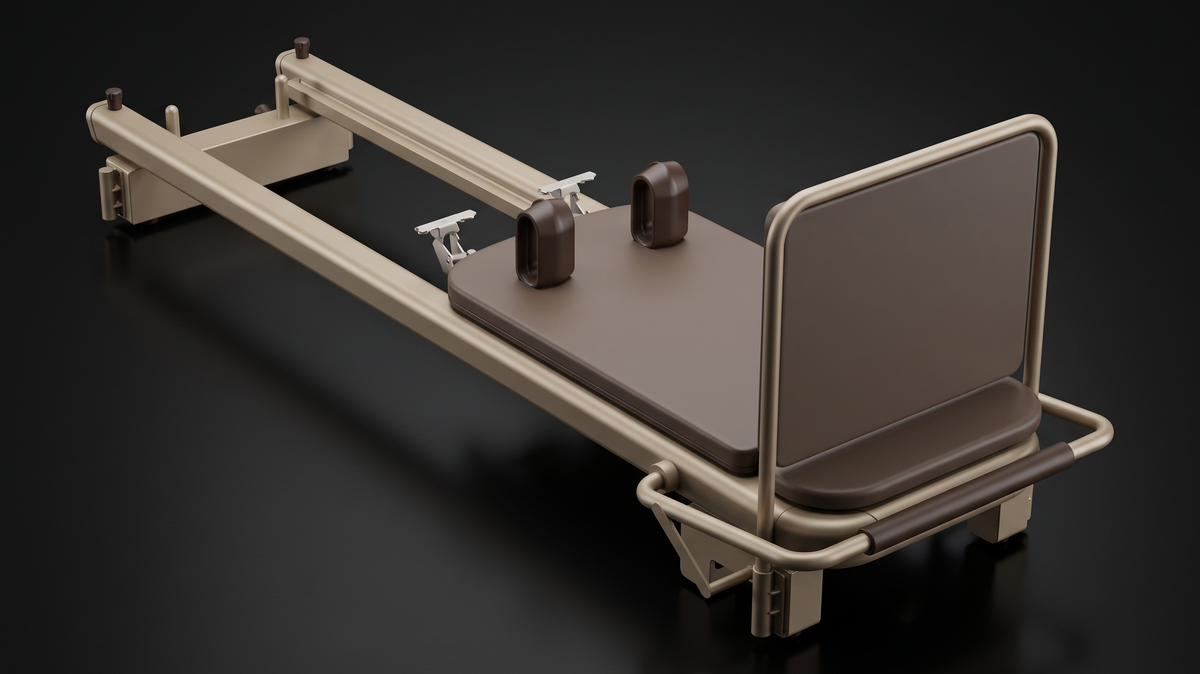
Jump board Pilates replaces the footbar with a padded board so you can jump while lying on the carriage. Because you are horizontal and the springs carry the load, it becomes low-impact power and cardio training: you push away from the board, travel with the carriage, and land softly to push again. The skill is not jumping high. It is landing well.
Written by the Elemental Movement Lab and reviewed by Samantha Giam, certified classical Pilates instructor. Updated 1 October 2026. This guide brings together our own teaching with three leading Pilates references, listed at the end.
Before you start: equipment and safety
- Only use a jump board made for your reformer, fitted exactly as the manufacturer instructs. Check it is secure before every session; repeated jumping puts a twisting load on the mount.
- Elemental Reformer TerraStudio™ is designed with a four-point connection system for compatible jump board accessories. For Elemental Reformer TerraFold™, ask us about compatible options before fitting any board.
- Wear grip socks or go barefoot so your feet do not slip on the board.
- Lie with your shoulders against the shoulder rests and your head down, and check the shoulder-rest bolts are tight.
- If you are pregnant, managing pelvic floor symptoms, or have ankle, knee, hip or bone-health concerns, get individual advice first.
How a jump works: four phases
| Phase | What happens | What you should feel |
|---|---|---|
| 1. Load | Knees and ankles bend, feet flat on the board | The legs coiling, ready, the pelvis heavy on the carriage |
| 2. Push | Hips, knees and ankles straighten together and the feet leave the board | Power from the seat and the back of the legs, through to pointed toes |
| 3. Flight | The carriage travels away while the legs stay organised | The deep abdominals holding the legs and pelvis still |
| 4. Land | Toes, then balls of the feet, then heels meet the board as the knees bend | A soft, quiet catch that turns straight into the next jump |
The landing is the most important phase. The muscles work eccentrically, lengthening under load, to absorb the force and control the carriage's return. A good landing feels fluid, never jarring.
The anatomy: what is working
| Role | Muscles | Their job |
|---|---|---|
| Power | Gluteus maximus, quadriceps, calves (gastrocnemius and soleus) | Extend the hips, knees and ankles to drive away from the board. |
| Landing | Calves, quadriceps, glutes and the small muscles of the feet | Absorb force as they lengthen, in sequence from the foot up to the hip. |
| Balance | Hamstrings and inner thighs | Counter the front-of-thigh bias and keep the knees tracking over the toes. |
| Centre | Transversus abdominis, obliques, pelvic floor | Hold the pelvis and spine still so the force goes into the legs, not the back. |
| Upper body | Latissimus dorsi, triceps | The arms press down into the carriage to anchor you. |
Jump board work tends to favour the front of the thighs. Focusing on full hip extension and using the glutes and hamstrings keeps it balanced.
The key moments you should really feel
- The full push. At take-off, the hips straighten completely without the lower back arching. You feel the seat finish the movement.
- The quiet landing. You feel the foot roll from toes to heels and the knees soften, catching the carriage like landing on a cloud.
- The rebound. As the landing turns into the next push, you feel the calves and Achilles load and release like a spring. This is the plyometric part.
- The still centre. Through every jump, you feel the abdominals keep the pelvis heavy and steady on the carriage while the legs work.
How people get it wrong
| Mistake | What it looks like | The fix |
|---|---|---|
| Chasing height | Big, uncontrolled jumps and crashing landings | Stick the landing first. Height comes later. |
| Loud, flat-footed landings | The heels slap the board first | Land toes, balls, then heels, as if peeling your feet off Velcro and placing them back down. |
| Back arching | The lower back lifts off the carriage on the push | Keep the pelvis heavy and the ribs soft. Straighten the hips without arching. |
| Knees collapsing inwards | The knees knock in as you land | Track the knees over the second toes. Press evenly through both feet. |
| Uneven legs | One leg pushes harder; the carriage drifts | Slow down and feel both feet leave and land together. |
| Too much spring | Heavy, grinding effort and lost form | Load should serve your alignment. If form breaks, reduce it. |
| Holding the breath | A red face, a tight neck | Keep breathing. Let the rhythm settle into the jumps. |
| Going on too long | Technique fades as fatigue builds | Work in short intervals and stop before the landings get loud. |
Variations: a progression ladder
| Level | Variation | What it builds |
|---|---|---|
| 1 | Footwork on the board without leaving it, pressing out and back | Alignment and foot mechanics |
| 2 | Small parallel jumps, feet hip-width | A quiet, controlled landing |
| 3 | Heels together, toes apart (Pilates V) | Inner-thigh and glute control |
| 4 | Wide second position | Hip control in a wider base |
| 5 | Changing positions in the air, such as parallel to wide and back | Coordination at speed |
| 6 | Alternating single legs, the other knee held in tabletop | Single-leg power and pelvic stability |
| 7 | Side-lying jumps | Glute medius and lateral stability |
| 8 | Interval sets, such as 60 seconds on and 30 seconds off | Cardio conditioning |
How to breathe
Breathing during jumping is less formal than in other Pilates work. As your heart rate rises, it naturally becomes rhythmic and spontaneous. Two guidelines matter.
- Learning and slow jumps: exhale on the push, when the body needs the most power, and inhale as you land and load.
- Faster interval work: let the breath find its own steady rhythm, such as in for two jumps and out for two jumps. Never hold it.
If you cannot breathe steadily, slow down or take a break. Breath that is out of control means technique soon will be.
FAQs
Is jump board Pilates good cardio?
Yes. Sustained intervals raise the heart rate while keeping impact low.
Does jump board Pilates work the glutes?
Yes, along with the calves, quadriceps and hamstrings, especially when you focus on full hip extension.
How long should a jump board session be?
Start with intervals of one to two minutes within a reformer session and build gradually. Stop when your landings stop being quiet.
Is it good for runners?
Many runners use it to build power and elasticity without the pounding of road running. See Pilates for Runners and Surfers and Pilates Reformer Springs Explained.
Sources
This guide triangulates our own teaching with three leading references. Wording and recommendations are our own.
- The Pilates Journal, Jumpboard Decoded
- Pilates Bridge, Pilates Jumpboard Jumping Defies Vertical Jumping and Gravity
- Pilates Anytime, Amy Havens, Jump Board Flow and Maria Leone, Jumpboard Reformer


