
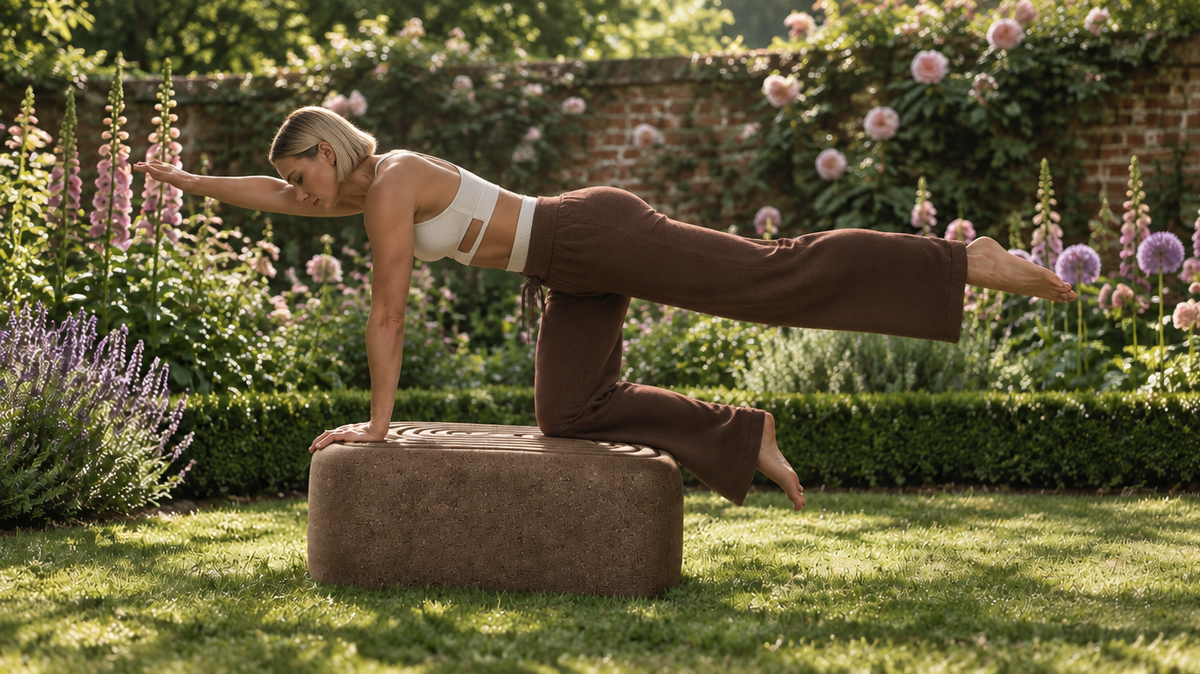
A Pilates box is a firm supportive accessory used to change height, positioning and the relationship between the body and the reformer or floor. On a reformer, it creates a larger surface for seated, side-lying, prone and other programmed exercises. Off the reformer, some boxes add elevation and support to mat Pilates, stretching and yoga practice.
Written by the Elemental Movement Lab and reviewed by Samantha Giam, certified classical Pilates instructor. Updated 30 September 2026.
What is a Pilates box?
The traditional Pilates box is a firm rectangular support, often timber and upholstered, placed on a reformer carriage in different orientations. It is commonly called a reformer box or Pilates sitting box. See Pilates Box vs Reformer Box vs Sitting Box.
What does a Pilates box do?
A box changes geometry. It raises the body above the carriage or floor, creates a larger sitting or lying surface, and provides a defined point of contact for the hands, feet or torso. That makes different exercise setups possible without changing the reformer itself.
What exercises use a reformer box?
Boxes appear in many Pilates schools and contemporary repertoires. Depending on the equipment, method and experience, a box may be used for seated work, side work, pulling-strap variations, supported positions and more. Follow the manufacturer's guidance and learn unfamiliar setups from a qualified instructor.
Can you use a Pilates box without a reformer?
Some boxes also act as raised supports for mat practice. The key considerations are stability, intended loading and the manufacturer's instructions. A box designed only for a particular reformer setup should not be treated as a general-purpose step or weight-bearing platform.
Can you use a Pilates box for yoga?
Yes, when the box is designed for floor use. Yoga practitioners typically use blocks and bolsters to bring the floor closer, support seated postures or soften deep stretches. A larger box does a similar job with a broader, more stable base: it can raise the hips in seated forward folds and meditation, support the spine in gentle backbends, or give the hands a higher surface in standing postures. Use it only in positions that suit its shape and stated loading.
Pilates box vs yoga block: what's the difference?
| Yoga block | Pilates box | |
|---|---|---|
| Size | Small, hand-sized | Large enough to sit or lie on |
| Main use | Bringing the floor closer to the hands | Elevating and supporting the whole body |
| Reformer use | Not designed for the carriage | Designed for the carriage |
| Typical materials | Foam, cork, wood | Upholstered timber, or moulded foam such as EPP |
What is a Pilates sitting box?
“Sitting box” is a common name for the firm box used with a reformer. The term describes one use, but the accessory supports more than seated exercises.
What should you look for in a Pilates box?
- Dimensions appropriate to your exercises and reformer
- A stable shape and a surface that gives grip and feedback
- Materials suited to sweat, repeated contact and cleaning
- A manageable weight if you move it between reformer, mat and room
- Clear compatibility and loading guidance from the manufacturer
Why rethink the traditional box?
Traditional boxes work but can be bulky to store and move, their flat tops give little tactile feedback, and upholstery can become slippery with sweat. Elemental developed Pebble™ as a lighter, sculpted interpretation that moves between the Elemental reformer, the mat and yoga practice.
Pebble™ at a glance
- Size: 70 cm long × 45 cm wide at its widest × 30 cm high
- Material: one-piece 100% expanded polypropylene (EPP): light, resilient and moisture-resistant
- Surface: waisted form with concentric grooves for tactile feedback
- Colour: Partridge, PANTONE 18-1124 TPX, supplied with a carry tote
- Compatibility: Elemental reformers and mat practice; non-Elemental reformers not verified
- Availability: order now; factory release 6 November 2026; one-year limited warranty
See the Pebble™ fact sheet, or see it in person at Living Edge in Sydney (from December 2026) and Commune Furniture in Singapore.
Pilates box FAQs
Do you need a Pilates box for reformer Pilates?
No. Much of the reformer repertoire uses no box. A box expands the available setups rather than being required for every session.
Can any Pilates box fit any reformer?
No. Carriage dimensions, shoulder blocks and box geometry vary. Check compatibility before use.
Is a Pilates box only for sitting?
No. Depending on its design and the exercise, a box supports several body orientations and positions.
Can a Pilates box replace yoga blocks?
It complements rather than replaces them. A box offers a larger, higher base for seated and supported postures; blocks stay useful for smaller adjustments under the hands.
How do you clean a foam Pilates box?
Unupholstered moulded foam can usually be wiped down with a damp cloth and mild soap, then air-dried. Always follow the product's own care guidance.


