
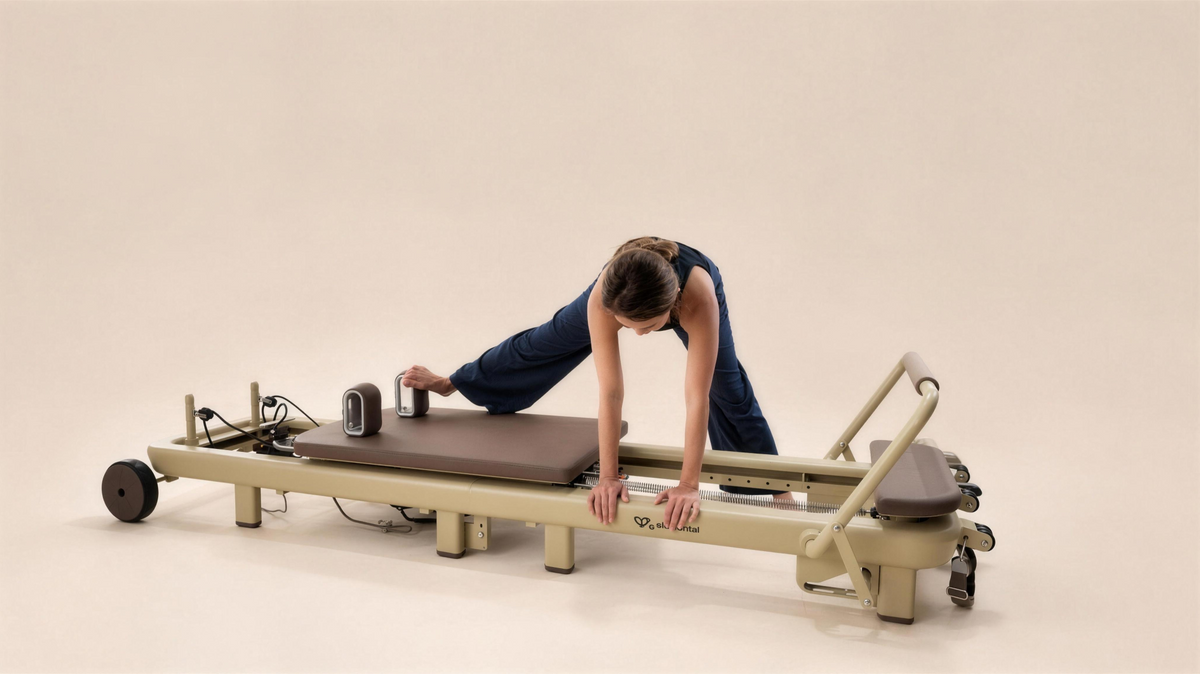
Lean, Side Bend and Hawk are seated box exercises from the reformer Short Box family, in which the springs are set heavy so the carriage stays still and your feet are anchored while the trunk moves. The Lean hinges back with a flat back, the Side Bend lifts up and over to the side, and the Hawk combines a side bend with a twist on a long diagonal. The skill they share is lifting up before you move, so the body lengthens instead of collapsing.
Written by the Elemental Movement Lab and reviewed by Samantha Giam, certified classical Pilates instructor. Updated 1 October 2026. This guide brings together our own teaching with three leading Pilates references, listed at the end.
Before you start: setup and safety
- Set the springs heavy so the carriage does not move. On an Elemental Reformer TerraFold™, use the setting your instructor recommends for box work, and check the carriage stays still before you sit.
- Place the box across the carriage in the short-box position, against the shoulder rests, and make sure it sits square and steady. Elemental Reformer Pebble™ is designed for this, with a grooved surface that grips and gives feedback.
- Anchor the feet securely in the way your instructor shows you for your reformer. Your feet are what you lean against, so this matters.
- Sit far enough forward that both sit bones are fully on the box.
- These exercises are not usually for a first session. Back, neck or hip concerns need individual advice.
The three exercises at a glance
| Lean | Side Bend | Hawk | |
|---|---|---|---|
| Also called | Flat Back, Short Box Reach | Side to Side, Side Overs | Short Box Hawk |
| Position | Sitting facing forward, feet anchored | Sitting facing forward, or side-on to the box | Side-on, one leg folded on the box, the other anchored |
| Movement | Hinge back from the hips, spine straight | Lift up, then bend sideways | Tilt to a long diagonal, then rotate |
| Main challenge | Holding length against gravity | Bending upwards, not collapsing | Combining side bend, twist and balance |
Lean and Side Bend come from the classical Short Box Series. Hawk is a contemporary exercise from the STOTT PILATES® repertoire. Names and setups vary between schools.
The anatomy: what is working
| Exercise | Prime movers | Lengthening | Stabilisers |
|---|---|---|---|
| Lean | Abdominals and hip flexors control the hinge back and the return | Front of the hips | Back extensors keep the spine straight. Inner thighs and outer hips press into the anchor. |
| Side Bend | Internal and external obliques, quadratus lumborum | The opposite side of the waist, the ribs and the muscles between them | Transversus abdominis. Glutes and legs keep both sit bones down. |
| Hawk | Obliques for the bend and the twist | The side of the body and the chest | Shoulder stabilisers and the deep core for balance on one anchored leg |
The key moments you should really feel
Lean
About halfway back, with the upper back still level with or higher than the box, you feel the abdominals working hard and the front of the hips holding. The return should feel like being drawn up from the centre, not pulled up by the neck.
Side Bend
Before you bend, lift up out of the waist. At the side, you feel the long stretch down the upper side of your body and the underside working to hold you, as if reaching over a large ball. Coming back up, you feel the waist on the lower side draw you home.
Hawk
On the long diagonal, the crown of your head and the anchored foot reach away from each other and you feel the whole side of the body light up. As you rotate, you feel the obliques wring the ribs around while the pelvis stays still.
How people get it wrong
| Exercise | Mistake | The fix |
|---|---|---|
| Lean | Rounding the spine or arching the lower back on the way back | Go back only as far as the spine stays straight, the upper back level with the box or higher. |
| Lean | Pulling up with the neck and shoulders | Return from the centre. Keep the chin level and the shoulders down. |
| Side Bend | Bending without lifting first | Grow tall out of the waist, then go up and over. |
| Side Bend | Collapsing the ribs on the lower side | Keep length on both sides, bending upwards rather than sinking. |
| Side Bend | The opposite sit bone lifting off the box | Bend only as far as both sit bones stay down. |
| Hawk | Twisting from the hips | Keep the pelvis still and rotate from the ribcage. |
| All | Feet not anchored, or the box shifting | Reset the setup. Never lean against an anchor you do not trust. |
| All | Holding the breath to hold the position | Keep a steady rhythm. If you cannot breathe, reduce the range. |
Variations: a progression ladder
| Level | Variation | What it builds |
|---|---|---|
| 1 | Lean, arms crossed on the chest, small range | Trunk control against gravity |
| 2 | Lean, arms reaching forward or overhead | A longer lever and more abdominal load |
| 3 | Side Bend, hands behind the head, small range | Lift before bending |
| 4 | Side Bend holding a pole overhead | Even length on both sides; imagine sliding the pole across the ceiling |
| 5 | Lean with a twist | Rotation with a straight spine |
| 6 | Hawk with the lower hand on the box, no rotation | The long diagonal and balance |
| 7 | Full Hawk with rotation | The complete exercise: bend, twist and balance together |
How to breathe
Breathing in box work is deliberately flexible, and the references agree there are two valid approaches. Exhaling as you lift helps the deep abdominals stabilise, which suits learners and modified versions. Inhaling as you lift encourages length and opens the ribs, which suits the full versions once you have control. This is the pattern we teach.
| Exercise | Inhale | Exhale |
|---|---|---|
| Lean | Hinge back with a straight spine | Return to sitting tall |
| Side Bend | Lift tall, then bend over to the side | Return to the centre |
| Hawk | Tilt to the long diagonal | Rotate, then return |
Breathe wide into the sides and back of the ribs, especially in the Side Bend, where the breath helps open the upper side. Never hold your breath.
Are these beginner exercises?
Lean and a small-range Side Bend can be introduced early with an instructor. Hawk is advanced. Treat all three as repertoire to learn in person once you are comfortable with the reformer and box setup.
FAQs
Why do I feel unstable on the box?
Check that the box is square and steady, the feet are anchored and the carriage is not moving. Reduce the range and make sure the box surface is dry.
Why do I feel the Lean in my lower back?
The lower back is arching to hold you. Come forward a little and draw the abdominals in.
What does Side Bend work?
The obliques and the deep muscles along the side of the trunk, with the hips and legs stabilising. Read What Is a Pilates Box? for more on box work.
Sources
This guide triangulates our own teaching with three leading references. Wording and recommendations are our own.
- Pilates Intel, Clare Dunphy, The Short Box Series Deconstructed
- Birmingham Pilates Studios, Reformer Short Box Series: Side to Side
- Merrithew, Exercise of the Month: Hawk on the Short Box


