
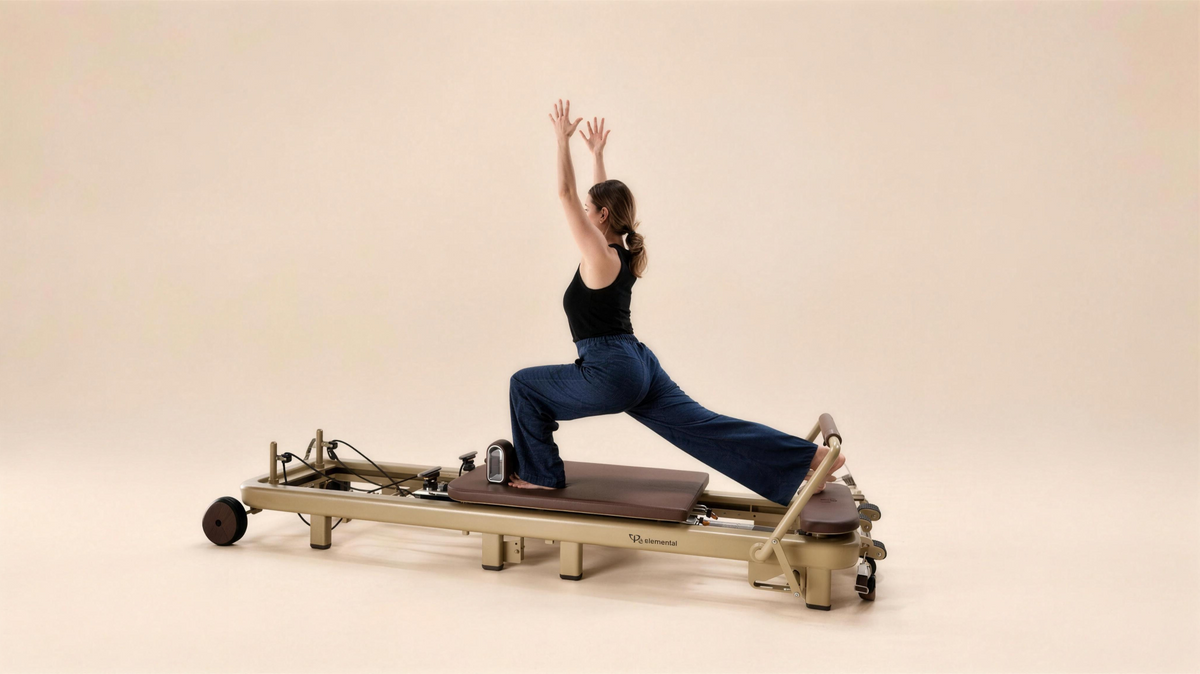
Reformer splits are standing exercises in which one foot stays fixed and the other rides the carriage, so the legs open and close under spring tension while the trunk stays tall. The classical series is Side Splits, Front Splits and Back Splits. They look like flexibility exercises, but the real work is strength: the springs are always trying to pull you apart, and you have to draw yourself back together with control.
Written by the Elemental Movement Lab and reviewed by Samantha Giam, certified classical Pilates instructor. Updated 1 October 2026. This guide brings together our own teaching with three leading Pilates references, listed at the end.
Before you start: safety on your reformer
- On an Elemental Reformer TerraFold™, your fixed foot goes on the standing platform at the footbar end, never on the footbar itself. The footbar has no lock and is held only by its own weight, so it is not designed to take a standing foot.
- The moving foot presses against the shoulder rests, so check that the shoulder-rest bolts are tight first.
- Mount with control: step both feet onto the carriage, then move one foot to the platform. Keep the carriage closed until you are set.
- Learn on heavier springs first. Lighter springs make splits harder, not easier, because you have less help closing the carriage.
- A pole or a hand on a wall nearby can help with balance while you learn.
The three splits at a glance
| Side Splits | Front Splits | Back Splits | |
|---|---|---|---|
| Facing | Sideways across the reformer | Towards the footbar | Away from the footbar |
| Moving leg | Opens out to the side | Back leg presses the carriage back | Front leg slides forward with the carriage |
| Plane of movement | Side to side | Front to back | Front to back |
| Main challenge | A level pelvis | A square pelvis and a straight back leg | An upright trunk |
| Typical springs | Medium, progressing to light | Medium | Medium |
Names, orientation and spring settings vary between schools. Learn your version with an instructor.
The anatomy: what is working
| Exercise | Prime movers | Stretching | Stabilisers |
|---|---|---|---|
| Side Splits | Inner thighs (adductors) close the carriage. Gluteus medius and minimus control the opening. | Inner thighs | Transversus abdominis, obliques and the glutes keep the pelvis level. |
| Front Splits | Glutes and hamstrings of the back leg press the carriage. Quadriceps of the front leg bend and straighten. | Hip flexors and front of the thigh on the back leg | Deep abdominals and hip rotators keep the pelvis square and still. |
| Back Splits | Hamstrings and glutes of the front leg draw the carriage home | Hamstrings of the front leg, hip flexors of the back leg | Back extensors and abdominals hold the trunk upright. |
The key moments you should really feel
Side Splits
At the widest point, with the springs pulling you open, you feel the inner thighs engage and the centre lift up and in. Closing the carriage is where the work is: you feel the inner thighs drawing together as if zipping the legs up into the pelvis.
Front Splits
As the back leg straightens and presses the carriage away, you feel a long stretch through the front of the back hip and the seat of that leg working. Bending the front knee and returning, the front thigh controls the descent while the pelvis stays level, not bobbing up and down.
Back Splits
As the front leg slides away, you feel the back of that thigh lengthen. Drawing the carriage home, you feel the hamstrings pull and the back stay tall.
How people get it wrong
| Mistake | What it looks like | The fix |
|---|---|---|
| Chasing depth | Going lower than you can control on the way back | Only use a range you can close with control. Depth comes later. |
| Riding the springs | The carriage snaps back and bangs home | Pause at the open and closed positions so momentum cannot do the work. |
| Pelvis tipping | One hip drops or the body leans to one side | Keep both hip bones level, as if a tray of water sits across them. |
| Pelvis bobbing in Front Splits | The hips rise and fall as the knee bends | Lower and lift in a straight vertical line, and move the carriage from the back leg. |
| Back leg bending in Front Splits | The knee softens as the carriage moves | Press the back leg firmly straight, foot turned out slightly against the shoulder rest. |
| Locked knees | The standing knee snaps back into hyperextension | Keep a micro-bend so the leg muscles, not the joint, take the load. |
| Ribs flaring, back arching | The chest pops forward as the legs open | Close the ribs gently and lengthen up through the crown of the head. |
| Losing the centre | Collapsing into the hips at the widest point | Lift through the centre to bring the carriage in, rather than pulling with the legs alone. |
Variations: a progression ladder
| Level | Variation | What it builds |
|---|---|---|
| 1 | Side Splits on heavier springs, small range, holding a pole | Carriage control and a level pelvis |
| 2 | Side Splits, full range, pausing open and closed for three counts | Strength at both ends of the movement |
| 3 | Side Splits on lighter springs | More inner-thigh and centre control |
| 4 | Front Splits, bending the front knee only | Balance and a square pelvis |
| 5 | Front Splits, front leg straight, carriage moving | Hip-flexor length under load |
| 6 | Back Splits | Hamstring control with an upright trunk |
| 7 | Side Splits with arm work, such as reaching or a twist | Coordination. Only add arms once the carriage stays still at both ends. |
How to breathe
| Exercise | Inhale | Exhale |
|---|---|---|
| Side Splits | Open the carriage under control | Draw the legs together and close the carriage |
| Front Splits | Bend the front knee | Press the carriage back by straightening the back leg |
| Back Splits | Slide the front leg forward | Draw the carriage home, lifting tall |
Some schools reverse the Side Splits pattern, exhaling to open. Choose one pattern and keep it steady. Breathe wide into the sides of the ribs and never hold your breath.
Are reformer splits suitable for beginners?
They are usually introduced after foundational carriage control, balance and lower-body work. Hip, knee or pelvic concerns, including during pregnancy and postpartum, need individual guidance.
Are reformer splits the same as floor splits?
No. Floor splits are a passive stretch. Reformer splits ask you to control a moving base under spring tension, so strength and balance matter more than flexibility.
FAQs
Do deeper splits mean better Pilates?
No. A controlled range you can close smoothly is worth more than a deep split you cannot get out of.
Why do I feel it in my knee?
Often the standing knee is locked, or the knee is not tracking over the foot. Soften it slightly and check alignment. Persistent knee pain needs individual assessment.
Are reformer splits good for runners and dancers?
Many use them for controlled hip mobility and single-leg strength. See Pilates for Runners and Surfers, then continue with the Long Stretch Series and Arabesque.
Sources
This guide triangulates our own teaching with three leading references. Wording and recommendations are our own.
- Pilates Anytime, Sarah Bertucelli, Front Splits
- Pilatesology Encyclopedia, Front Splits and Side Splits
- Inspired Academy, Reformer Pilates: Side Splits


